
 By Thomas Cohen, founder of Maestro
Rebuilding business software: when and how should you proceed?
When should you rebuild a business application? Signals to examine, stages, data migration and budget: a method for deciding and preparing the transition.
Rebuilding business software means evolving or reconstructing an existing tool while preserving the working rules and data the business depends on. It becomes useful when fixes are no longer enough: recurring outages, duplicate entry, difficult maintenance or an inability to adapt the tool. Before rebuilding, compare targeted improvements, replacement with an off-the-shelf product and a gradual rebuild.
When should you rebuild a business application?
Start by observing a complete work cycle. Record operations that get blocked, errors corrected manually and information copied between tools. An old interface alone does not justify rebuilding. However, an application nobody knows how to maintain, an important rule that cannot be changed, or outages that interrupt operations deserve an assessment.
For each problem, write down its frequency, the people affected and the concrete consequence. For example: every Friday, two colleagues copy orders into a spreadsheet because the export lacks the correct status. This description lets you check whether fixing an export is enough before committing to rebuilding the entire application.
Improve, replace or rebuild the business tool?
Improve the existing tool if its rules remain correct and problems are limited to a few screens, exports or slow responses. Consider an off-the-shelf product if your needs are standard and you can retrieve your data. Consider rebuilding if the limitations affect several essential functions and your particular rules cannot fit into available solutions.
The first deliverable is a reasoned decision, not a new interface. You need to know what you are keeping, what you are changing and how you will check the result. To clarify these choices, use a requirements document written without technical jargon.
Step 1: document the old software's rules
Inventory the screens in use, data, exports and connections to other tools. Ask the people working with the application to describe exceptions: a discount reserved for one customer, approval above a threshold, a case reopened after closure. Keep an anonymised real example for each important rule, with the expected result.
AI agents can help read accessible code and propose a description of its processing. But code does not always reveal users' workarounds or decisions made outside the tool. Review the file with the people who do the work and explicitly flag unknown areas. This work forms your product's memory, even if you decide to postpone rebuilding.
Step 2: rebuild a first verifiable module
Choose a limited scope whose results you can compare with the old system: an export, tracking dashboard or viewing screen, for example. Write the cases to check before building. A search must find the same records; a total must match on the same data; a person without permission must not see a restricted case.
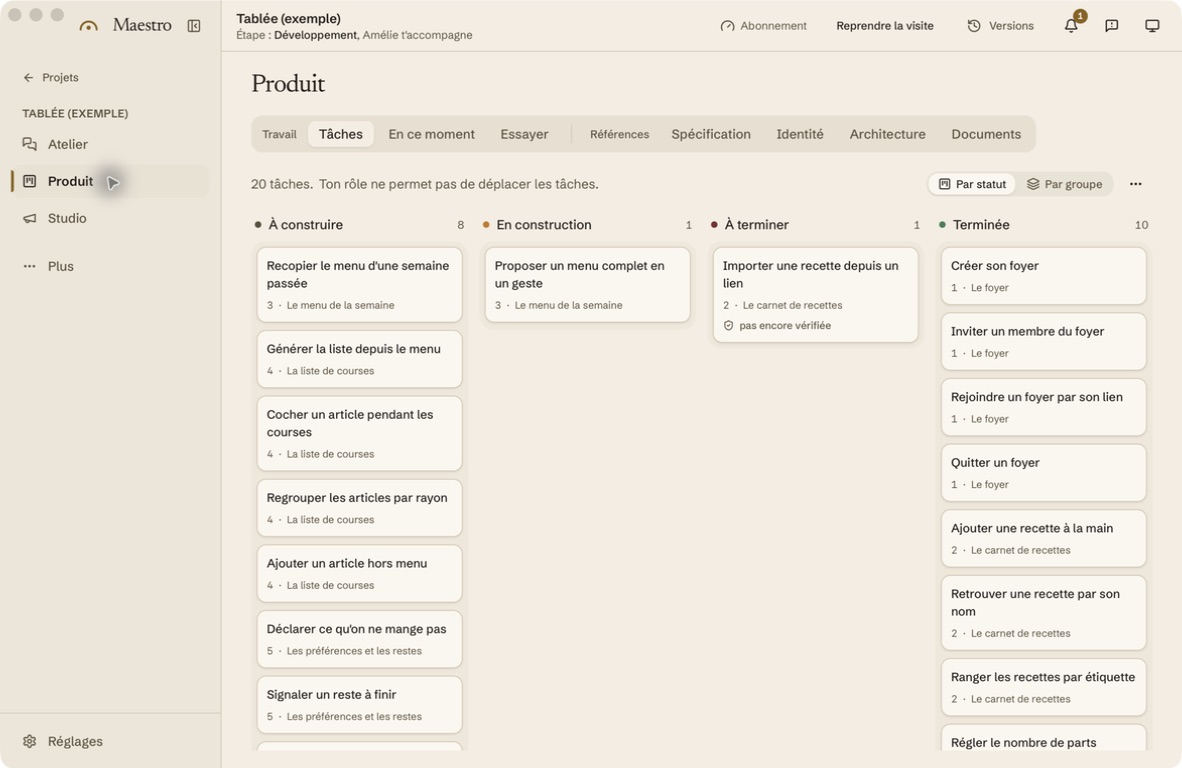
Maestro's takeover workflow starts from what exists to produce an assessment and documents you correct before development. The agents then build in stages, subject to your approval. This assistance does not remove the need to check rules, access and results with the users concerned.
Step 3: prepare data migration
Keep a backup of the original and work on a copy first. Map fields, identifiers and relationships between records. After a trial import, compare record counts, amounts and a few complete histories. Every rejection must be explained and corrected before switchover. Our guide to migrating data into an application details this check for Excel files.
Distinguish restoring the software from restoring its data: reverting to an earlier code version does not restore entries made since then. Plan who backs up data, who can restore it and how operations carried out during an interruption will be handled.
Step 4: switch gradually with a return plan
Test the new module over a representative work cycle before expanding it. If both tools coexist, identify the authoritative one and specify how entries are transferred: two independently modified databases eventually diverge. Decide in advance which discrepancies would require returning to the old tool and who authorises the switchover.
Then retain useful history in read-only form and document the new habits. The rebuild is complete when users can perform their tasks and results have been checked, not merely when the new screens display.
How much does rebuilding business software cost?
The cost depends on the number of rules to preserve, data quality, external connections and necessary checks. Request separate estimates for the assessment, first module, migration and support. Compare that scope with improving the existing system; our development cost comparison offers reference points without replacing a rebuild quote.
AI expenses represent only part of the work. Add users' time, testing, hosting and future maintenance. For a critical system or complex integrations, involve a competent person to verify the design and launch. Maestro's free beta does not make those items free.
The first step: a one-page decision file
Bring together the most costly everyday problem, the rules to preserve, the data to retrieve and a first module to test. Add the person who will approve the result and the criterion that would make you abandon the rebuild. You will have a concrete basis for consulting a provider or discovering how Maestro takes over an existing tool.