
 By Thomas Cohen, founder of Maestro
Your specifications will soon be worth more than your code
AI makes code abundant. Understanding becomes the scarce resource: knowing what you wanted to build, and why. Three levels of maturity are emerging.
For decades, a software project's asset was its code. It was protected and billed for. Documentation followed, when it followed at all. AI agents are reversing that order: code is produced, fixed and regenerated on demand. What directs production, and retains value when everything else can be rebuilt, is the specification: the text saying what the product must do, for whom, and under which conditions we will know it has succeeded.
Music has known this hierarchy for a long time. An orchestra performs; the score remains. Musicians change, instruments change, yet the work can be performed the same way because the intention is written down. A product's code is an interpretation. Your specification is the score.
Understanding debt
Software can work without anyone knowing which business rules it applies, which assumptions a developer coded one evening without writing them down, or how to evolve it without breaking something else. This understanding debt existed long before AI: it is what orphans a product when its developer leaves. But agent-generated code multiplies it, because producing has never been so easy, and postponing understanding has never been so tempting. A working product nobody understands is a house without plans: habitable, but impossible to sell or repair.
Three levels of maturity
Three practices are emerging in how specification and code relate, from the most common to the most ambitious.
The first, called spec-first: the specification starts generation, then each goes its own way. Code evolves with requests; the specification stays in its drawer. Productive at the start and fragile afterwards: week after week, the gap widens between what the text promises and what the product does.
The second, called spec-anchored: specification, code and tests evolve together in a closed loop. Every important requirement has verifiable criteria, and automated tests continually check that the product does what the text says. When one of the three changes, the other two follow. This is today's realistic balance: the speed of generation, with control added.
The third, called spec-as-source: code is no longer touched at all. Only the specification, rules and criteria change, and the software regenerates as a projection of that knowledge. Appealing on paper, still experimental in practice.
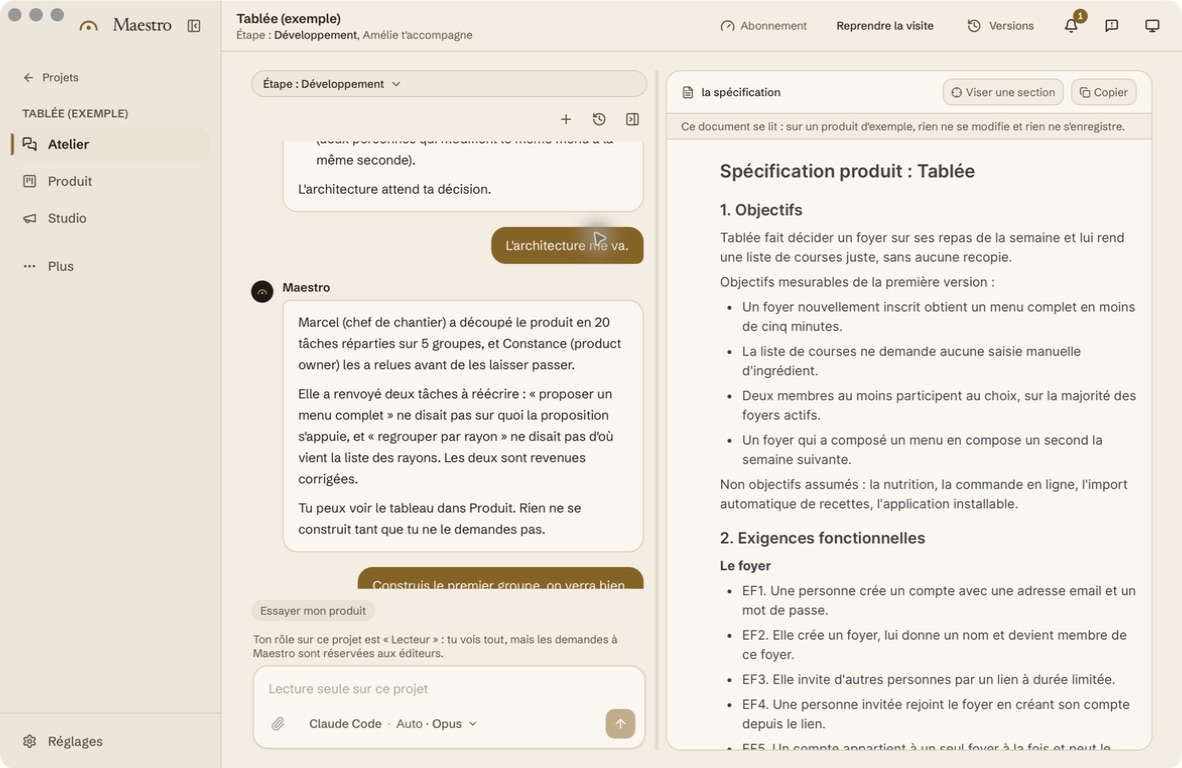
A good specification does not prevent errors
Better specifications do not eliminate agents' mistakes: an agent can still invent, misinterpret or take a shortcut. A specification with verifiable criteria changes the status of an error: you detect a measurable deviation early, while it still costs little, instead of discovering silent drift weeks later. Human vigilance becomes manageable at scale.
Your assets when you commission a product
If you direct a product without coding it yourself, this shift is excellent news, provided you follow through on its consequence: your assets are your documents, the brief, your business rules, user journeys and the criteria that say ‘this is successful’. Whoever owns these texts owns their product, because they make everything else rebuildable: changing tools, changing providers, commissioning a new audit or rebuilding without starting from a blank page. Code alone depreciates as machines learn to write it.
And the skill gaining value belongs to the product owner: formalising an intention and deciding on rules, describing a journey in their own language, provided a tool presents readable documents and waits for their approval. That is the bet behind Maestro's method, but the lesson goes beyond the tool: wherever you build, demand documents you can read, correct and take with you.
The question is changing
Yesterday, a project's strategic question was: what have we coded? It is becoming: what have we specified, and who understands it? AI will generate the code. Understanding is written, approved and maintained, and that work is yours from today.